AI Machine Vision for Manufacturing: Complete Guide to Automated Quality Inspection & Zero Defect Production (2026)
How deep-learning computer vision systems detect micro-defects at line speed, eliminate human error, and power Zero-Defect manufacturing.
Dalnex Team
Computer Vision & AI Quality Engineers
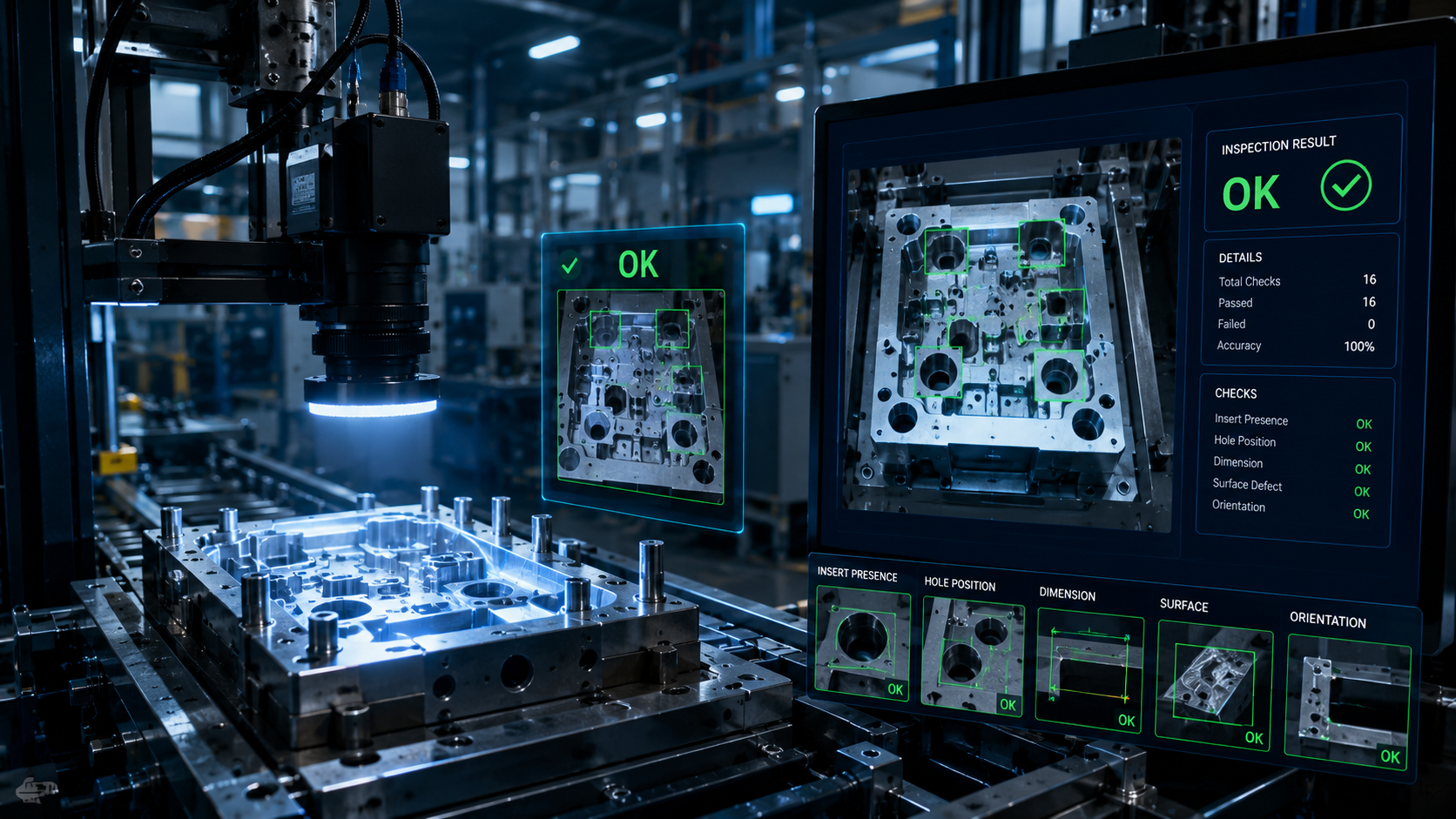
Product quality has become one of the biggest competitive advantages in modern manufacturing. Customers expect defect-free products, tighter tolerances, and complete traceability, while manufacturers must reduce inspection costs, eliminate human error, and increase production speed.
Traditional manual inspection methods are often inconsistent, slow, and difficult to scale. As production volumes increase, maintaining consistent quality becomes even more challenging.
This is where AI Machine Vision is transforming manufacturing.
AI-powered Machine Vision systems use industrial cameras, advanced imaging, and artificial intelligence to inspect products in real time. They can identify defects, verify components, measure dimensions, detect missing parts, and ensure product quality with high speed and accuracy.
From plastic injection molding and automotive manufacturing to electronics, pharmaceuticals, and packaging, AI Machine Vision is helping manufacturers move toward Zero Defect Manufacturing while improving Overall Equipment Effectiveness (OEE), reducing scrap, and lowering operational costs.
What is AI Machine Vision?
AI Machine Vision is a computer vision system that combines industrial cameras, lighting, imaging technology, and artificial intelligence algorithms to automatically inspect products and manufacturing processes.
- Surface defects (scratches, dents, cracks, voids, sink marks)
- Missing components and omitted fasteners
- Incorrect assembly or misaligned parts
- High-precision product dimensions and tolerance limits
- Color shade and surface texture variations
- Label presence, alignment, and print clarity
- High-speed 1D Barcode and 2D DataMatrix / QR code reading
- Brass/steel insert presence and seating verification in injection molds
- Weld seam continuity and integrity inspection
- Packaging seals, cap tightness, and carton integrity
Why Manufacturers Need AI Machine Vision
Manual quality inspection presents severe human and financial limitations on high-speed shopfloors:
- Human eye fatigue and loss of concentration after hours of repetitive scanning
- Inconsistent inspection criteria across day and night shifts
- Micro-defects and subtle flaws missed during high-speed transit
- Slow inspection speeds creating bottlenecks at line ends
- Rising labor costs and high turnover of inspection personnel
- Inability to achieve 100% part inspection on high-volume production
How AI Machine Vision Works
A 5-step millisecond pipeline from optical capture to automated sorting
High-Resolution Image Capture
Industrial CMOS cameras with calibrated telecentric or fixed-focal lenses and pulsed strobe lighting capture crisp images as parts move down the line.
Edge Image Pre-Processing
Edge hardware normalizes contrast, removes environmental ambient noise, and aligns the region of interest (ROI) in real time.
Deep Learning AI Analysis
Convolutional neural networks (CNNs) evaluate the image against trained defect models to classify cracks, scratches, missing inserts, dimensional deviations, and flash.
Instant Decision Making
The system categorizes parts as Pass, Fail, or Rework within milliseconds, logging the defect type and high-resolution snapshot.
Automated Line Action
A direct digital trigger activates pneumatic reject arms, diverters, or stops the injection cycle if an unseated mold insert is detected.
Key Capabilities of Modern AI Vision Systems
- Automated Visual Inspection: Complete hands-off visual grading without human intervention.
- Deep Defect Detection: Detects complex scratches, dents, porosity, flash, sink marks, and texture anomalies.
- Mold & Insert Verification: Confirms presence, depth, and orientation of metal inserts before mold clamping to prevent million-dollar tool crashes.
- High-Precision Dimensional Metrology: Sub-millimeter measurement of critical tolerances, gap widths, and concentricity.
- OCR & Code Reading: Verifies lot numbers, expiration dates, barcodes, and serial numbers for regulatory traceability.
- Line-Speed Real-Time Monitoring: Inspects 100% of parts without throttling production output.
- Continuous AI Learning: Model retraining capability improves inspection accuracy as new part variations are introduced.
- Live Quality Dashboards & Analytics: Visualizes defect Pareto charts, shift scrap rates, and mold cavity performance in real time.
AI Machine Vision vs Manual Inspection
| Manual Human Inspection | AI Machine Vision (VisionOS) |
|---|---|
| Operator dependent & subjective | 100% Fully Automated & Deterministic |
| Fatigue severely reduces accuracy | Consistent 24/7 Precision (99.9%+) |
| Statistical batch sampling (5–10%) | 100% Inline Piece-by-Piece Inspection |
| Slow, creates production bottlenecks | Millisecond High-Speed Execution |
| Human error causes customer escapes | AI Accuracy Trained on Thousands of Images |
| Difficult & costly to scale with shifts | Instantly Scalable Across Multiple Lines |
| High recurring labor & rework costs | Lower Operational Cost & Fast Payback |
Common Manufacturing Applications
- Automotive: Engine block porosity checks, weld seam tracking, stamping surface flaw detection, fastener verification.
- Plastic Injection Molding: Short-shot detection, flash prevention, insert seating, part ejection confirmation, mold cavity inspection.
- Electronics & SMT: Solder joint bridging, missing surface-mount chips, polarity orientation, connector pin straightness.
- Pharmaceuticals: Blister pack completeness, vial liquid levels, cap crimp verification, expiry date OCR validation.
- Packaging & Bottling: Fill levels, tamper band seals, cap seating, barcode print quality, label alignment.
- Metal Fabrication: Burr detection, sheet metal scratch inspection, thread verification, punch hole count.
How to Implement AI Machine Vision
Define Quality Inspection Requirements
Specify defect types, smallest allowable flaw size (e.g. 0.1 mm), cycle time constraints, and pass/fail thresholds.
Select Appropriate Industrial Cameras & Optical Lighting
Engineer lighting angles (backlight, coaxial, dome, or dark-field) and optics to highlight flaws with maximum contrast.
Collect Sample Images for AI Model Training
Capture sample images of good parts, marginal tolerances, and known defect variations under production lighting.
Train and Validate Deep Learning Models
Iteratively train neural network weights and validate on test sets to achieve target 99.9%+ precision.
Integrate Vision System with PLCs and Rejection Gates
Connect hardware triggers, encoder pulses, and pneumatic blow-off flippers for automatic defective part sorting.
Monitor Performance & Continuously Refine
Review false-positive and false-negative telemetry on live dashboards to continuously fine-tune sensitivity.
The Future of AI Machine Vision
Next-generation computer vision is evolving with game-changing breakthroughs:
- Edge AI Micro-Processors: High-throughput neural processing units (NPUs) built directly into industrial smart cameras.
- 3D Laser Profile & Stereoscopic Vision: Capturing point-cloud depth for complex 3D geometric validation.
- Generative AI for Synthetic Defect Generation: Creating rare anomaly training data without waiting for physical machine breakdowns.
- Self-Supervised Anomaly Detection: Systems that learn what a good part looks like and flag any deviation with zero defect pre-labeling.
- Multi-Camera Synchronized Arrays: 360-degree cylindrical product inspection at thousands of bottles per minute.
Frequently Asked Questions
Achieve Zero-Defect Manufacturing with Dalnex VisionOS
VisionOS by Dalnex is an AI-powered machine vision solution that automates quality inspection, insert verification, mold inspection, and defect detection in real time. Designed for modern manufacturing, it integrates seamlessly with production lines to improve quality, reduce scrap, and support Industry 4.0 initiatives.
Experience Dalnex Smart Manufacturing
Connect your machines, eliminate blind spots, and achieve measurable OEE improvements in as little as 30 days with FactOS & VisionOS.
Related Manufacturing Guides
What is a Factory Operating System? Meet FactOS by Dalnex – The Complete Guide for Smart Manufacturers (2026)
Discover how a modern Factory Operating System connects machines, people, and processes to boost OEE and eliminate shopfloor downtime.
Read Guide Production MonitoringProduction Monitoring Software: Complete Guide to Features, Benefits, ROI & Implementation (2026)
Learn how automated production tracking unlocks actionable shopfloor insights, slashes downtime, and maximizes plant profitability.
Read Guide Industrial IoTIndustrial IoT (IIoT) Platform Explained: Complete Guide to Smart Manufacturing & Industry 4.0 (2026)
Understand IIoT architecture, industrial protocols, edge computing, and how connected factory ecosystems empower predictive manufacturing.
Read Guide